
The cable laying-up vs conductor stranding distinction starts with what enters the machine and what must leave it. Both processes bring multiple elements together, but they act at different stages of cable production. A machine chosen to combine bare wires into a conductor is not automatically the right machine to assemble insulated cores into a cable.
The short distinction: bare wires or insulated cores?
Conductor stranding combines individual metallic wires into a conductor with a defined geometry. Depending on the product, the conductor may be round, compacted, sector-shaped or segmented. Cable laying-up assembles already insulated or sheathed cores into the required multi-core arrangement. Fillers or a binder may be added according to the cable design before later production stages.
These are process descriptions, not rigid labels for every machine. Some cage configurations can process different input types when correctly specified. The production drawing and machine configuration determine the actual application.
| Question | Conductor stranding | Cable laying-up |
|---|---|---|
| Typical input | Individual bare copper or aluminum wires | Insulated or sheathed cores |
| Immediate output | A stranded metallic conductor | An assembled multi-core cable structure |
| Key geometry | Wire arrangement, conductor shape and lay | Core arrangement, cable diameter and lay |
| Questions for the supplier | Wire size, conductor design, compacting and tooling | Core size, back-twist, fillers, reel handling and downstream process |
Where the stages appear in a cable route
A simplified example begins with bare wires that are stranded into a conductor. The conductor then receives insulation in a separate process. If the final cable has several insulated cores, a laying-up stage arranges those cores together. Shielding, wrapping, armoring and sheathing may follow according to the finished design. A single cable does not necessarily require every listed stage; the approved construction determines the route.
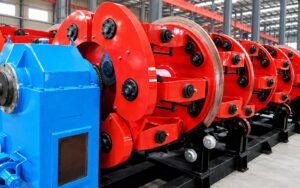
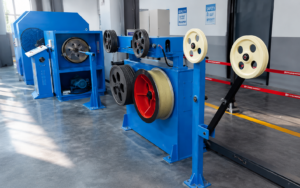
BYC lists a frame strander for bare-metal conductor applications, including selected shaped and compacted conductors. Its cable forming machine is presented for laying up insulated cores in larger cable structures. The smaller cage-type strander has its own published applications and configuration choices. These pages are starting points, not proof that one model fits every design.
Why tension and back-twist need separate questions
Both stages need controlled material delivery, but the material being handled is different. Bare metallic wire, a finished insulated core and a larger sheathed core can have different allowable forces and surface sensitivity. Ask for a tension range and control method that applies to the proposed material and reel, rather than accepting a generic statement that the line has tension control.
In laying-up, back-twist may help manage how an insulated core rotates about its own axis while the assembly is formed. Whether it is needed, and at what setting, depends on the cable construction and process plan. Its presence on a machine brochure is not a substitute for confirming the required product structure.
Which details should a buyer send?
- For conductor stranding: bare-wire material and diameter, number and arrangement of wires, target conductor geometry, lay range, and any compacting or pre-twisting requirement.
- For laying-up: core count and layout, outside diameter of each incoming core, finished diameter at this stage, filler or wrapping requirement, lay direction, and back-twist requirement.
- For either process: reel drawings and loaded weights, target output, upstream and downstream equipment, plant layout and utility conditions.
If the immediate question is which type of strander to buy, see the separate cage versus frame strander guide. That article compares two stranding-machine families; this guide identifies which production stage the buyer needs to specify first.
Frequently asked questions
Is laying-up just another name for stranding?
The terms can be used loosely in sales conversations, but the input and required output should be stated precisely. A request to assemble insulated cores is different from a request to form a bare conductor.
Can a cage strander be used for both?
Some configurations may serve more than one application. Check the exact model, input sizes, reel positions, tension system and tooling against the product drawing before treating the applications as interchangeable.
Does a larger machine always cover smaller products?
No. Material handling, tension range, reel size and changeover needs can rule out an apparently broad choice. Compare representative products, not only maximum diameter.
To discuss the right process stage, send BYC the incoming-material details and target cable construction rather than only a machine name.