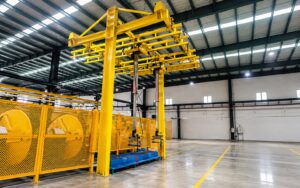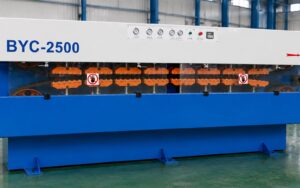

A cage strander and a frame strander can both bring multiple wires together, but the right choice starts with the cable you need to make. Are you stranding bare copper or aluminum into a conductor, or assembling finer wires and insulated cores? The finished structure, incoming material, lay length, and line layout matter more than the machine name or headline speed.
The short answer
- Consider a cage strander for the wire or core sizes and product structures covered by a particular cage model. BYC offers smaller configurations for finer copper or aluminum wires and larger configurations that can also handle selected insulated cores.
- Consider a frame strander when the main task is stranding bare copper or aluminum conductors, especially when a round, sector-shaped, or segmented conductor calls for suitable pre-twisting or compacting tooling.
- Compare both configurations where their applications overlap. Material size, finished geometry, tension, reel handling, and the rest of the line determine the recommendation.
These are starting points, not absolute rules. Confirm the exact cable design before selecting a model or agreeing on an output target.
Where each machine fits
A 400–800 cage strander carries multiple supply positions in rotating cages. Depending on the model and setup, it can be considered for flexible copper conductor work and selected insulated-core cabling jobs. BYC also lists a smaller cage-type strander for finer material. Its hysteresis-tension and active-pay-off versions have different published ranges; evaluate them separately.
BYC presents its frame strander primarily for bare copper and aluminum conductor stranding. Listed applications include round, sector-shaped, and segmented conductors, with pre-twisting or compacting as required by the design. It is a relevant starting point when conductor geometry is the critical requirement.

Four checks before you decide
1. Define the finished structure
Specify whether the output is a bare stranded conductor, a compacted conductor, or an assembly of insulated cores. Include the number and arrangement of elements, conductor shape, lay direction and length, and the applicable standard or drawing. Bobbin count describes supply positions; it does not automatically equal the number of cores in a finished cable.
2. Specify the incoming material
List copper or aluminum, bare wire or insulated core, the diameter of each incoming element, and its handling limits. Do not substitute finished cable diameter for single-wire diameter. BYC publishes model-specific ranges; for example, its JLK500 and JLK630 frame-strander specifications list different minimum copper-wire diameters. Check the proposed model against the actual input material.
3. Check tension, reels, and tooling
Ask how pay-off tension is controlled for your material, which reel dimensions and loaded weights the line accepts, and how reels are loaded. If pre-twisting or compacting is required, identify the tooling and finished profile in the RFQ. Do not treat a model number as a confirmed reel size without checking the specification.
4. Match the rest of the line
Confirm pay-off, traction, take-up, guarding, floor space, power supply, and control interfaces. The proposed line must maintain the specified lay and handle the product safely from entry to take-up.
Why maximum rpm is not the answer
A published cage rotation speed is a limit for a stated machine configuration. It is not cable travel speed or guaranteed production output. Lay length, material behavior, bobbin loading, tension, traction, and take-up all affect usable speed. Request a proposed operating speed and acceptance method for your cable construction rather than comparing isolated rpm figures.
What to send with your RFQ
- Finished conductor or cable drawing, shape, dimensions, lay direction, and lay length.
- Incoming material, single-wire or core diameter, quantity, and surface requirements.
- Reel dimensions, loaded reel weight, and preferred loading method.
- Required pre-twisting, compacting, tension control, and quality checks.
- Target output, operating schedule, and upstream and downstream machines.
- Available floor layout, power supply, guarding needs, and factory acceptance criteria.
With one production brief, BYC can compare the cage strander and frame strander configurations on the same basis. Ask its engineering team to confirm any requirement outside a published range in the quotation.
Frequently asked questions
Can a cage strander replace a frame strander?
Some applications overlap, but the machines are not interchangeable by default. Compare material range, conductor geometry, tooling, tension, and complete line configuration for the specific product.
Does a 24-bobbin machine make a 24-core cable?
No. Twenty-four bobbins describe available supply positions in a cage configuration. The actual strand or core arrangement depends on the cable design and line setup.
Which machine is faster?
There is no universal answer. Compare proposals for the same material, finished construction, lay length, and acceptance standard. A higher maximum cage rpm does not establish higher stable production output.