
Copper wire and copper tape can both form a metallic screen, but they are different cable constructions and require different application equipment. The correct choice starts with the cable drawing and applicable standard, not with a machine speed figure. This guide helps purchasing and engineering teams identify what to confirm before requesting a shielding line.
Begin with the screen specified for the cable
Confirm the required screen material, geometry, coverage or electrical continuity criteria, and the layers immediately before and after screening. A copper-wire layer is made from individual wires laid around the cable core. A copper-tape layer uses a continuous strip wrapped around the core. The completed screen depends on wire count or tape dimensions, lay or overlap, contact between elements, and the cable design. Neither process is a universal substitute for the other.
If a customer specification explicitly calls for copper wires or copper tape, use that construction as the starting point. Any change in material or geometry should be approved by the cable designer and checked against the applicable standard before equipment is selected.
Copper-wire shielding: questions to answer
A copper-wire shielding machine places multiple individual copper wires around the moving cable core. In the BYC range, published models run from 315/72 to 400/80, with listed copper single-wire diameters varying by model from 0.4 to 4.0 mm. The number of supply positions and the acceptable wire diameter must be checked together; the model name alone is not a complete specification.
Ask for the required wire count, single-wire diameter, intended lay direction and length, incoming cable-core diameter, reel details, and acceptable wire tension. Wire handling and preforming also matter, especially when the screen must sit consistently around a changing cable diameter. Confirm the finished construction with your cable engineering team rather than inferring screen performance from a machine photograph.
Copper-tape shielding: questions to answer
A copper-tape shielding machine wraps strip material around the cable core. BYC publishes TP500 and TP630 configurations with copper-tape widths of 10–60 mm. The listed center-channel diameters are 120 mm and 140 mm respectively; those are pass-through dimensions, not a promise that any cable at that outside diameter can be processed.
Specify tape width and thickness, the intended wrap direction, overlap or coverage, incoming core diameter, tape reel dimensions, and the required tension arrangement. The proposed tooling and line layout should also account for the tape edge, surface condition, and downstream layers. A higher listed head rpm cannot by itself establish usable production speed for your cable.

How to compare the two processes
- Required construction: follow the drawing and the relevant cable standard before comparing equipment.
- Incoming material: document copper wire diameter and count, or tape width and thickness; these are not interchangeable inputs.
- Core geometry: provide the actual diameter entering the screening stage and any variation along the product.
- Tension and coverage: ask how the proposed line maintains the specified lay, overlap, or wire arrangement at the target operating speed.
- Line integration: check pay-off, traction, take-up, guarding, floor space, and interfaces with adjacent wrapping or extrusion stages.
Send a useful RFQ, not just a machine name
Attach the cable cross-section and relevant standard. State the screen construction, incoming cable-core diameter range, material dimensions, reel sizes and weights, target operating speed, upstream and downstream equipment, and inspection criteria. Ask the supplier to identify any assumptions and to confirm the configuration against a sample or drawing.
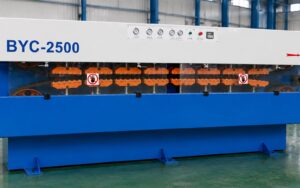
Review the BYC copper-wire shielding machine and BYC copper-tape shielding machine as two different starting points for a quotation. Where the published ranges do not answer your project question, request a model-specific engineering response.
Frequently asked questions
Can I replace copper tape with copper wire to simplify purchasing?
Only if the cable design authority confirms that the revised construction meets its electrical and mechanical requirements. Equipment availability alone is not a basis for changing the screen.
Does a larger center channel mean a larger finished cable is supported?
Not necessarily. It describes the machine pass-through opening. Tooling, operating clearance, adjacent equipment, and the cable construction determine the workable range.
Which process is faster?
Compare proposed operating conditions for the same cable design. Maximum machine rpm, material dimensions, tension, and the required wrap or lay all affect the result; isolated catalog maxima are not comparable production guarantees.