
Cable pay-off and take-up equipment must be specified together with the main processing machine. Material must enter the process on suitable reels, move through it at a controlled rate and leave on a reel that can be handled safely. An otherwise suitable strander, laying-up machine or armoring machine can be difficult to run if the line-end arrangements were specified separately from the rest of the line.
This guide focuses on line-end compatibility, reel handling and finished winding. For the difference between magnetic hysteresis and active pay-off tension, read the separate pay-off tension guide.
Identify the material at each end
Begin with a simple line drawing. At the input, identify whether each supply position carries bare wire, insulated core, tape or another material. At the output, identify what is wound: a stranded conductor, a laid-up cable core or a later-stage cable. Record the diameter and approximate weight per unit length for the representative products. The input and output reels may have very different dimensions and loading needs.
For each reel type, supply its flange diameter, barrel diameter, overall width, shaft opening and maximum loaded weight. A photograph can help identify a reel, but a dimensioned drawing is more useful for confirming fit. Do not infer lifting capacity from reel diameter alone.
Match reel handling to the operating pattern
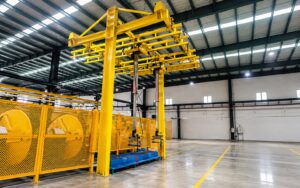
A plant that changes small reels frequently has a different handling problem from one that runs long batches with heavy reels. Ask how a full reel enters the machine, how an empty reel leaves, which lifting equipment is available and how much clearance exists around the line. BYC’s bobbin loading device page describes different arrangements that can be matched to machine layout and handling requirements. The appropriate choice and its rated load need project-level confirmation.
Plan for the operator’s work as well as machine fit. Reel loading, threading and changeover should have a defined access path. Include guarding and maintenance clearance in the plant drawing rather than measuring only the main machine footprint.
Specify take-up and traversing together
Take-up rotates the output reel; traversing guides the cable across its usable width. Ask how the two movements are coordinated for your cable diameter and reel geometry. Poorly matched winding can create uneven layers, edge build-up or handling problems on the next process. The correct traversing arrangement is a property of the reel, cable and line conditions together, not a universal number taken from a brochure.
BYC’s collecting and arranging cable rack is listed for take-up, traversing and reel winding. Its published description says the arrangement is selected for reel size, cable dimensions and layout; it does not publish one take-up speed or reel capacity for every installation. Ask for those values in the project proposal.
Check traction and speed coordination
Where the line uses a haul-off unit, its contact method and required pulling force must suit the product surface and process. BYC lists both a crawler tractor and a wheel tractor. The choice should be based on cable dimensions, acceptable surface pressure, required traction and the physical line arrangement.
Ask the supplier how the main machine, haul-off and take-up respond during starting, stopping and reel changes. Comparing only their separate maximum speeds does not demonstrate that they will run together at a stable working speed for the intended cable.
Send one set of line-end data in the RFQ
- Input and output product descriptions, including diameter range and representative constructions.
- Dimensioned drawings and maximum loaded weights for each supply and output reel.
- Target working speed, batch length and expected changeover frequency.
- Available crane or forklift capacity, loading route and operator access space.
- Existing main machine, haul-off, take-up and control equipment to be retained.
- Required winding quality, documentation and trial conditions for representative products.
Frequently asked questions
Is the take-up reel size enough to choose a rack?
No. Loaded weight, cable diameter, usable winding width, line speed, traversing and available floor space also matter.
Does a higher motor power prove a higher pulling force?
No. Ask for a documented traction rating and the conditions under which it applies. Motor power alone is not a pulling-force specification.
Can the pay-off and take-up be quoted after the main machine?
They can be scoped separately, but their interfaces should be defined before purchase. Otherwise reel fit, control signals or line layout may need later changes.
For a line-end configuration review, share your reel drawings and existing line layout with BYC.